Introducing: Amish Tripathi
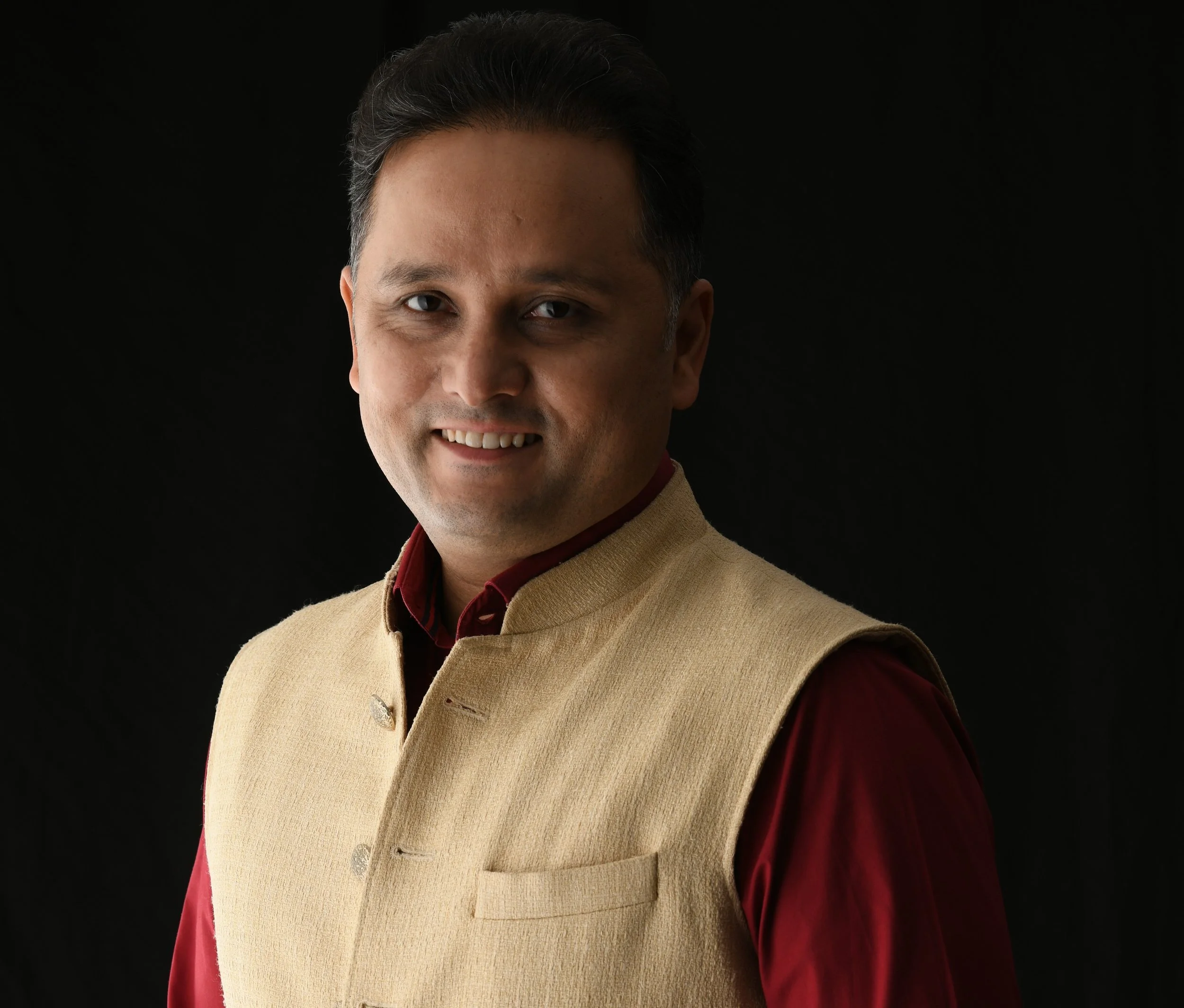
Amish Tripathi is an author, former diplomat & broadcaster.
He published his first book in 2010 and has written 12 books (both fiction and non-fiction) till date. His books have sold over 8 million copies and been translated into 21 Indian & international languages. He is the fastest-selling author in Indian publishing history.
Forbes India has regularly ranked Amish among the top 100 most influential celebrities in India. Among his recent awards are the prestigious Dwarka Prasad Agarwal award at the Jaipur Lit Fest 2024 & Best Factual Presenter in a Documentary at the Asian Academy, Singapore 2025. He was awarded an Honorary Doctorate by the University of York, UK, in January 2026 for his contributions to Literature & global cultural dialogue.
As a broadcaster, he has hosted many documentaries with Warner Bros Discovery, NDTV & Jio India. Among them are Legends of the Ramayan with Amish (2022), Journey of India (2022) & Legends of Shiva with Amish (2025), MahaKumbh Tales with Amish (2025). He has produced & hosted the highly acclaimed & blockbuster documentary Ram Janmabhoomi – Return of a Splendid Sun (2024); the Ram Janmabhoomi documentary was the most watched Indian documentary of 2024 and the 4th most watched non-fiction show overall (an unprecedented viewership for a serious documentary in a reality TV dominated market like India).
In his diplomatic role, Amish worked as the Minister (Culture & Education) at the Indian High Commission to the UK (equivalent to Embassy) and the Director of The Nehru Centre in London from 2019 to 2023. This role was within the Ministry of External Affairs in the Indian Government (equivalent to the US State Department).
He is an alumnus of the prestigious Indian Institute of Management (IIM), Calcutta; He received the Eminent Alumnus Award from IIM-Calcutta in 2017. He worked for 14 years in senior roles in the financial services industry before turning to full-time writing.
Tell us about your early years – which city you were born in, where you were brought up and your academic and other interests during your early years.
I was born in Mumbai, in a simple, middle-class, deeply religious Hindu family that valued both faith and education. I spent a big part of my childhood near Rourkela in Odisha, Ooty in Tamil Nadu, and in other parts of India, which helped me see the diversity of our great country from a young age.
At home, conversations about God, history, and philosophy were normal, thanks in part to my grandfather, who was a priest and teacher at Banaras Hindu University, and to my parents, who pushed me to read and think. That mix of religion and learning naturally drew me towards our traditions, scriptures and philosophy.
I studied at The Lawrence School, Lovedale, The Cathedral & John Connon School in Mumbai, then St. Xavier’s College, Mumbai, where I did a BSc in mathematics, followed by an MBA from IIM Calcutta. All through these years, I was a heavy reader, especially of history, spiritual and philosophy texts, and for some time I even wanted to be a historian, before choosing management and finance for practical monetary reasons.
Outside academics, I enjoyed sports like boxing and gymnastics, and I also sang as the lead-vocalist of a band in IIM Calcutta. Looking back, the mix of stories, history, faith, numbers, sport, and music all came together later in the way I think and write as an author.
Tell us which academic qualifications you hold, and from which universities? What were the years in which you secured them?
I completed my schooling at the Lawrence School, Lovedale and Cathedral & John Connon School in Mumbai. I then graduated with a Bachelor of Science in Mathematics from St. Xavier’s College, Mumbai in 1995, and subsequently completed a Post Graduate Diploma in Management (MBA equivalent) from the Indian Institute of Management Calcutta as part of the 1995–1997 batch.
You have held diverse roles – banker, diplomat, media person and author. What inspired you to switch from one to the next? Please tell us about your journey from one role to another. What was exciting and what was challenging when you took up a new role?
At every stage of my life, the shift has happened when the pull of a new calling became stronger than the comfort of what I was already doing. The thread that connects all my roles—banker, author, broadcaster & diplomat —is curiosity and a desire to serve India’s story in different ways.
I spent about fourteen years in banking and financial services after my MBA, and wrote my first book on the side purely out of love for the subject and devotion to Lord Shiva. When the 2nd book of Shiva Trilogy, Secret of the Nagas also took off, it became clear that writing could pay my bills as well, and that gave me the courage to leave a stable job for the exciting life of a full-time author.
Later, when the chance came to head The Nehru Centre in London and work as a diplomat for the Government of India, it felt like another way of doing what my books try to do—share India’s civilisational story with the world. Similarly, hosting documentaries and broadcasting also became a natural extension, using television and digital platforms to reach people who may never pick up my books.
Each transition has been thrilling because it opened new ways to tell India’s stories, and challenging because it meant stepping out of my comfort zone and learning everything again from scratch.
Do you see yourself as an even blend of these roles today, or do certain aspects of your professional background dominate over others?
A man is always a blend of all his experiences. Nothing is ever wasted – neither success nor failures, neither happiness nor grief. Everything adds up to make you who you are. And all those experiences show in the books that I write.
Are you able to share with us your most fulfilling moments in one or more of your roles?
The most fulfilling role ever is that of a father. And the most fulfilling moment of my life was holding my son, as soon as he was born. He is my pride and joy.
Having held multiple high profile public positions, what stand out to you as India’s biggest strengths and improvement opportunities in its aspiration to be a developed country by 2047?
India is returning as a great power after centuries of decline. As we become wealthier and more powerful, our narrative will have far greater heft across the world. This is one of the most exciting times in the recent history to be an Indian storyteller. It doesn’t matter if you communicate your stories through books, movies, video games, documentaries, podcasts or any other medium. What matters is that Indian stories will impact the world once again, just as we did in ancient times. Let a million stories bloom!
