Economic Reforms – Where India Stands Today
From facing a balance of payment crisis in 1990-91, India has come a long way, becoming one of the world’s largest economies today. Up till 1990, decades of government control stifled the country’s economic growth. India’s potential could be tapped only after it embraced economic reforms in 1991. While during early years governments were cautious in implementing reforms, over time economic policies have been based on growing conviction. Since 2014, broad and deep reforms, and other incentives, have been pursued at a faster pace by both the Union and state governments, making doing business in India more attractive. While all sectors have grown, manufacturing and professional services have grown especially rapidly to occupy large chunks of national GDP. The reforms in recent years have also made India the fastest growing large economy in the world.
While some areas, such as land acquisition, slow judicial process and pockets of over-regulation continue to be a drag on growth, the government has taken steps to address those, even as it continues to identify more opportunities for improving the experience of doing business in India.
Political stability at national and states level is a precondition for fast-paced meaningful reforms. The government also needs to have a clear, timebound vision for India’s growth and development, along with the ability to implement that vision. Since India’s reforms journey commenced, the present government is the first to have political stability in its favour. It has also declared its ambition to make India a developed country by 2047. With continued stability and focus, in coming decades, India has the potential to reach the heights to which it aspires.
Introduction
Emerging from colonial rule in 1947 India measured very poorly in social parameters such as life expectancy, literacy and per capita income. Becoming a free-market economy would have helped generate employment, over time lifting people from poverty and raising living standards. Instead, the government assumed upon itself the responsibilities of employment generation and wealth distribution across the population. To achieve this, it crafted policies to tightly control most aspects of economic growth. Instead of achieving its intended purposes, this model stifled India’s growth for over 40 years, including during the post-WW II global boom, which offered other developing countries a good window of opportunity.
India eased some import restrictions during second half of the 1980s, leading to faster outflow of foreign exchange. However, exports remained stagnant, leading to foreign exchange reserves shrinking. This led to fiscal and current account deficits progressively growing. The 1990 Iraq-Kuwait war disrupted India’s long term oil supplies from both countries, forcing expensive imports from other suppliers. The USSR, India’s strategic partner, accepted rupee payments for imports, offered long term credit and guaranteed a large export market for India. However, its break up in 1991 impacted these arrangements. These situations reduced international agencies’ confidence in India’s ability to repay its debts, in turn impacting availability of concessional aid to India. The government was forced to take expensive short term external debt. The unprecedented strain on foreign exchange reserves drove India to the brink of default on repayment of its international debt. To prevent such a crisis, the government had to pledge its sovereign gold and secure an emergency loan to repay its obligations.
This balance of payment (BoP) crisis became the trigger for India to usher reforms to make its economy resilient. The Statement of Industrial Policy, 1991 was the first step in this direction. Among its significant reforms were abolition of licenses for operating in all industries except those associated with environment, public health and national security; and inviting foreign direct investment (FDI) and foreign technology agreements in “high priority industries”.
Key figures speak of how 35 years of reforms have transformed India’s economy. Gross Domestic Product (GDP) grew from USD 1.1 trillion (nominal) in 1991 to USD 16.19 trillion in 2024. Foreign exchange reserves grew from USD 1.2 billion in 1991, covering just 2-3 weeks of imports with short term debt at 380% of reserves, to USD 701.4 billion in early 2026, providing an 11 months cover for imports with external debt at 94%. Between 1970 and 1990, FDI hovered between 0 and 0.1% as a percentage of GDP; it hit a high of 3.8% in 2008 before settling in at 0.7% in 2024. After 35 years of reform, India's economy is not only much larger, but much healthier.
India’s aspirations and key sectoral reforms
Possibly held back by ideological and political compulsions, the Indian National Congress – the party in power for much of India’s independent history, including during the BoP crisis – implemented reforms slowly. However, over time, caution gave way to growing conviction, and successive governments implemented deeper and broader reforms.
In 2014, the Narendra Modi-led coalition, the National Democratic Alliance (NDA), was voted to power, with his political party, Bharatiya Janata Party (BJP), securing an absolute majority in Lok Sabha (lower house of Parliament) – a first for any party since 1984. Such a mandate empowered the government to pursue reforms more confidently. As a result of their efforts, ease of doing business in India has risen from 142nd in the world in 2014 to 63rd in 2019. In 2019, the BJP and NDA won even larger numbers of seats, enabling Narendra Modi to declare early in his second term the government’s ambition to make India a developed country (Viksit Bharat) by 2047. Accordingly, the government pursued more reforms and other initiatives to uplift India socially and economically.
Meanwhile, driven by reforms, India’s economy too has evolved to look more like other larger economies. While agriculture was the economy’s biggest sector for decades, services and manufacturing have grown substantially in recent decades.
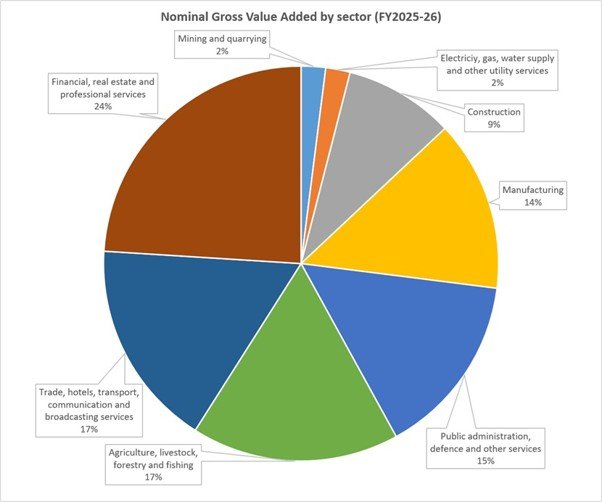
Source: Ministry of Statistics and Programme Implementation (MoSPI)
Manufacturing
India's early Congress governments rolled out the Industries (Development and Regulation) Act (IDR) in 1951 and Monopolies and Restrictive Trade Practices Act (MRTP) in 1969. The Industrial Licensing Policy (ILP), released nearly 20 years after the IDR, further reinforced its provisions.
The IDR declared a list of industries, including metallurgy, energy, telecommunication and industrial machinery, different aspects of which would be controlled by the government. Enterprises from those industries needed licenses to operate, which specified what they could manufacture, how much and in which part of India. Government-constituted bodies interfered with the enterprises’ governance and could take over a company’s control in “public interest”. The MRTP institutionalized harassment for enterprises aspiring to grow.
The 1991 industrial policy scrapped the need for compulsory licenses for all manufacturing except that related to environment, public health and defence. The amended MRTP gave companies freedom over investment decisions on matters related to expansions, mergers, takeovers and directorial appointments. The MRTP was replaced with the Competition Act, 2002, which was oriented to protect consumers’ interests. The latest reform in this space is the Competition Amendment Act, 2023, which has established a robust process for high value mergers. It introduced tighter timelines for decisions, actions and dispute resolution, ending long periods of uncertainty for stakeholders.
Starting in 1991, reforms also invited foreign investment and advanced technologies for a growing list of previously protected industries, like metallurgy, telecommunications, scientific research equipment, chemicals and pharmaceuticals.
In 2014, the NDA envisioned the ‘Make in India’ initiative, which identified 15 sectors to promote manufacturing in. Investment was incentivized by a variety of means – processes were rationalized, technology platforms enhanced to simplify compliance and production-linked incentives (PLI) offered for process improvements and innovations. In 2025 the government launched the National Manufacturing Mission, crafted to serve as an “overarching body for policies, incentives, and actions to drive India’s manufacturing future” by consolidating all enablers of Make in India.
During the covid pandemic, like countries across the world, India faced crippling supply chain disruptions that impacted manufacturing and distribution of goods. To prevent such an eventuality arising from any future global crisis, the government conceived ‘Atmanirbhar Bharat’, an initiative to make India self-reliant in key domains including defence, semiconductors, space sector, clean energy, critical minerals exploration, deepwater exploration, agriculture and fertilizers, digital sovereignty and pharmaceuticals. Manufacturing is an important aspect of self-reliance in these domains. Starting with a financial package worth 10% of India’s GDP, the government has incentivised investment in Atmanirbhar Bharat by various means.
Thanks to reforms and incentives to energise manufacturing, important domains have recorded robust growth. Defence equipment production rose 224% from 2014 to 2025, with exports growing 34-fold over approximately the same period, while production of electronic goods rose six times from 2014 to 2025. Pharmaceutical and medical manufacturing grew by over 10% annually from 2020 to 2025. Employment in organized manufacturing has grown from 4.48 million (page 3) in 1991 to 27 million in 2025. The improved business environment has also attracted global brands from diverse industries, including Airbus, Apple, Foxconn, Samsung, Nissan, Renault and Nestle to set up or grow manufacturing in India.
Technology services
Heavy protectionism impacted India’s Information Technology industry’s natural evolution through the mid-eighties. Since the Computer Policy of 1984 and subsequent reforms, IT has grown well, and is expected to continue to experience robust growth over the next decade. The 1980s policy shift gave IT services industry status, qualifying it for bank loans and duty exemptions. In addition, import duties on computer hardware and software were slashed, the need for licenses for operating was scrapped and restrictions on production were removed. In 1986, prohibition on technology infrastructure linking India centres with foreign customers was removed, enabling better provision of services. The National Association for Software and Service Companies (NASSCOM), a body representing IT industry, was set up in 1988. The industry was exempted from paying tax on profits from exports.
In 1991 the government set up Software Technology Parks of India (STPI), a body to promote the industry’s growth. Centres of excellence (CoEs), R&D centres, Artificial Intelligence (AI), cybersecurity and data science centres were set up in STPs. Exports from STPs have grown over 20,000 times from 1992 to 2025. Operating in STPs qualified companies for benefits such as 100% tax exemptions for five years, duty free imports, 100% foreign ownership, high speed digital infrastructure, single-window clearances and facilitation for exports. The Information Technology Act, 2000 strengthened regulation, such as providing legal recognition to electronic records, online transactions and cybercrime.
Product development contributes just 4.2% of India’s IT/ITES industry output. By 2030, the global product market is expected to grow by 70% its size in 2025. India’s domestic market is expected to reach USD 42 billion by 2031. In 2019 the government rolled out a product development policy. Its pillars include building a supporting ecosystem, single window for legal and regulatory approvals, enabling imports and exports, and providing funds for research and innovation. STPI has also introduced the Next Generation Incubation Scheme (NGIS), which promotes software product development start-ups. These reforms and incentives have contributed to India’s IT industry’s revenue growing from USD 118 billion in FY2014-15 to 283 billion (estimated) in FY2024-25. Collectively, IT and related services today account for over 12% GVA of all services, up from 6% in 2012.
Further, the government has incentivized foreign enterprises setting up global cloud services in India by offering them tax holidays until 2047. For setting up related data centre services, enterprises have been offered a safe harbour margin of 15% on costs. Compliance has been simplified with technology and technology-enabled services categorized as IT services, having a safe harbour margin of 15.5% for a five-year period, approved through an automated process.
Financial services
During the post-independence decades the government tightly controlled key aspects of banking, including interest rates, liquidity and reserve ratios; 40% of all lending was mandatorily for “priority” sectors like agriculture, irrespective of their business viability. Many of India’s thriving privately-owned banks were nationalised. All these factors blunted Indian banks’ competitiveness. Nationalization made political interference a systemic problem, driving up non-performing assets (NPAs) to alarming levels.
However, the economic reform wave also swept through India’s banking sector. As early steps, borrowing, lending and deposit rates were deregulated; credit reserve ratio and statutory liquidity ratio were reduced in phases; new private and foreign banks were permitted entry and prudential norms introduced based on Basel I Framework. The Reserve Bank of India’s (RBI) governance mechanism was adapted for these reforms.
NPAs have been the darkest legacy of bank nationalization. A fundamental cause for this was that from 1947 till 1991, NPAs lacked a formal definition, impacting their effective governance. According to some estimates, in 1989, “problem loans” of 33 banks formed 17.91% of their gross advances (not including amounts locked in sick industrial units). As a first step towards NPA governance, they were given a formal definition in early 1990s. In a significant reform, in 1994 nationalised banks were permitted to raise capital with private shareholding (with government retaining 51% ownership), which would aid in managing NPAs.
While reforms helped lower NPAs, in 2001 the NPAs to total loans ratio stood at 11.4%, far higher than the acceptable range of 2-5%. In 2002, the government implemented the Securitisation and Reconstruction of Financial Assets and Enforcement of Security Interest (SARFEISI) Act, under which banks could auction defaulters’ properties to reduce NPAs. In 2003, the RBI introduced a framework specifying automatic mandatory actions when (i) capital adequacy requirements were not met, (ii) NPAs crossed specified thresholds and (iii) returns on assets did not meet specified levels. This reform contributed to NPAs declining. While aggressive lending from 2006 led to ballooning NPAs again, rising to 11.4% in 2018, the NDA government pushed further reforms to stabilize the banking system. In 2015, the government conducted an Asset Quality Review (AQR) to understand banks’ loan stress levels and make suitable provisions. In further reforms, the 2016 Insolvency and Bankruptcy Code (IBC) consolidated and strengthened India’s bankruptcy laws; the 2018 Prompt Corrective Action (PCA) Framework strengthened financial risk management.
These reforms helped reduce NPAs to 2.15% of total loans in 2025. Since it came to power, the NDA government also drove financial inclusion on an unprecedented scale, leading to access to banking services for a large yet-unbanked section of India’s society. Collectively, these efforts contributed to an increase in deposits and credit by 162% and 171% respectively in 2025 from their levels in 2015. Foreign banks have had a presence in India since before independence. In Indian banks, FDI of up to 20% of paid-up capital in nationalised ones (since 1999) and 74% in private ones (since 2004) is permitted. International investors have showed growing confidence in India’s banking by investing in large and small private banks. India’s banking business is expected to grow from USD 15.97 billion in 2026 to USD 19.66 billion by 2031 (CAGR of 4.25%).
The insurance industry had a similar pattern of nationalization, followed by reforms. The Insurance Regulatory and Development Authority (IRDA) was established in 1999, followed by insurance being opened for private and foreign investment (26% stake) in 2000. In 2014 the cap for foreign stake was increased to 49%, in 2021 to 74%. In 2023, IRDAI declared the goal of ‘Insurance for all by 2047’. Aligned with this goal, significant reforms were announced in 2026. FDI in insurance has been increased to 100%. Unlike in the past, there is no longer a mandate for a majority of directors and management to be resident Indians; licensing requirements have been streamlined, and the regulatory framework and governance rationalized.
These series of reforms have driven growth in the insurance industry. Insurance penetration (insurance premium as a percentage of GDP) rose from 3.4% in 2016 to 4% in 2023. Other reforms and incentives include GST exemption, no claim bonuses, guaranteed policy renewal and premium refund on midterm cancellation.
The government also opened doors for portfolio investments early in its reforms journey. The Securities and Exchange Board of India (SEBI), the capital market regulator, was made a statutory body to ensure a robust regulatory framework is established and investors’ interests are protected. The National Stock Exchange was established as a competitor to Bombay Stock Exchange. Set up on technology infrastructure, the former introduced greater transparency and made the stock market more accessible to investors.
In the early 1990s India opened its capital market to foreign institutional Investors (FIIs). Subsequently, foreign investment in the Indian market was simplified with all categories of foreign investors being clubbed under Foreign Portfolio Investors (FPIs), with common regulations applicable to them. Rationalized licensing was introduced. This was followed by rationalizing compliance for long term investors. A recent reform to FPI in government securities (G-Sec) includes income tax exemption. Reforms in the two investment channels for G-Secs – General Route and Fully Accessible Route (FAR) List – include more investment options and relaxed restrictions.
Defence
A sector of strategic importance for India, defence was reserved for the public sector at independence. In reality, much of India’s defence equipment was imported, mostly from the erstwhile USSR. Indigenous production – which was limited – too was based on imported technology. In 1958 the Defence Research and Development Organisation (DRDO) was set up to promote indigenous defence equipment development. However, meaningful research and manufacturing continued to elude India.
In 2001 the government permitted the entry of private players and foreign investors (up to 26%) in defence manufacturing. Procurement procedures introduced subsequently mandated foreign vendors to invest a portion of contract values in the domestic industry (offset). Reforms introduced with the Defence Procurement Procedure, 2016, shortened procurement timelines. Under ‘Make in India’, the defence strategy has been to increase indigenous design and manufacture. Accordingly, the 2017 policy on Strategic Partnerships in Defence allowed private entities to manufacture bigger platforms such as fighter aircraft, submarines and armoured vehicles – till then the exclusive domain of government-owned units. Subsequently, 128 manufacturing licenses were issued to private parties. The government also incentivized domestic research with Innovations for Defence Excellence (iDEX), which has created an indigenous development ecosystem by engaging innovators. According to the Strategic Partnership Policy, shortlisted Indian companies could form partnerships with foreign companies having the right knowhow.
The Defence Ministry declared 2025 as the Year of Reforms, during which licensing, procurement, export and the ministry’s internal processes were streamlined. Equipment testing infrastructure has been made available to private parties. Other reforms include rationalization of licensing and export promotion processes, and establishment of defence industrial corridors to reduce transportation costs and time.
Self-reliance in defence preparedness is an important component of Atmanirbhar Bharat. To achieve this objective the government evolved the Defence Acquisition Procedure, 2020, aimed at prioritizing procurements from domestic suppliers over foreign ones. It also promoted indigenous design, development and manufacture (IDDM) among domestic players, and prioritized purchases from them. While research in the past has been conducted by the DRDO, of late, the government has also invited private domestic players to pursue it.
Defence production has grown by 174% from FY2014-15 to FY2023-24. Exports in defence equipment have grown exponentially from INR 6.86 billion in FY2013-14 to INR 236.22 billion in FY2024-25. This sector is expected to continue to grow in production and exports over the coming years.
Agriculture
Agriculture constitutes about 18% of the country’s GDP, employing over 42% of the workforce. Increasing productivity has been one of the government’s primary objectives, for which it has introduced technology solutions. It is using drones for crop monitoring, precision farming and spraying pesticide. It has also set up Agri Stack – digital infrastructure that offers cheaper credit and provides reliable data inputs to farmers.
India permits 100% FDI in food processing, horticulture, floriculture, development and production of seeds, aquaculture animal husbandry and tea plantations, although most FDI till now has been in food processing. As a result of the government’s initiatives, average annual foodgrain production over FY2005-14 and FY2014-23 rose by 24%. Between FY2015 and FY2025 exports too increased by 13.7%. Overall, the agriculture sector has experienced average annual growth rate of 4.4% in the last five years.
The government intended to roll out transformative reforms in 2020, which would have broken prevailing monopolies for purchase of produce. The reforms would also have removed some kinds of produce (such as cereals, pulses and edible oils) from essential commodities, paving the way for private purchase. Although passed in parliament, these laws had to be withdrawn after a year of politically-motivated protests. It remains to be seen if the government will implement them in future.
Energy and mining
For 45 years, India’s governments owned all aspects of energy generation and distribution, irrespective of their financial, technical and operational abilities to run the sector. The result was an economy gasping for all forms of energy. Large parts of India did not have power infrastructure for decades after independence. Cities and towns suffered regular power cuts. Infrastructure used was old and compromised. Power theft was rampant.
In 1991, power generation, transmission and distribution were opened to foreign investment. in 1998, parliament passed the Electricity Regulatory Commissions Act, scoped with rationalizing tariffs and subsidies, promoting competition and ensuring overall transparency and efficiency in power generation, transmission and distribution. The Electricity Act, 2003 simplified compliance by consolidating all prevailing electricity laws. It delicensed generation, permitted captive power generation, strengthened power trading and improved consumer protection.
Coal is the biggest energy source and will continue to be so in the country’s energy security journey. Successive governments have focused on increasing energy availability, both from mining and from imports. To boost local production, in recent years the government has introduced reforms to increase transparency and simplify regulations and processes associated with mining in India. These factors have contributed to record coal production of 1 billion tonnes in the last two financial years. To boost imports, early in the reforms journey, restrictions were relaxed on timelines, sources and quantity of imports. The most recent significant reform – Scheme for Harnessing and Allocating Koyala (coal) Transparently in India (SHAKTI), 2017 and 2025 – strengthens the coal supply process for thermal power plants by making coal linkages transparent and easing the procurement process for coal consumers.
The government opened transmission to private investment in 2003, although investors did not show much enthusiasm. As a means to attract investment, land acquisition to build transmission infrastructure has been enabled with guidelines that make the process transparent and fair. The government has started investing in a smart grid, which will improve efficiency and reliability of transmission infrastructure, making the sector more attractive to investors.
Distribution has been running in huge losses for decades, with unsustainable subsidies offered by state governments. Power theft adds to distribution companies’ (discoms) losses. Several attempts have been made to transform discoms and attract private investment. One such scheme, Ujwal Discom Assurance Yojana (UDAY), met with limited success. The Revamped Distribution Sector Scheme (RDSS) is replacing conventional electricity meters with smart meters. Although still in progress, RDSS has achieved good success so far. The Electricity Amendment Bill, 2025 strives to professionalise distribution by introducing competition between public and private companies; it rationalizes tariffs and subsidies and strengthens regulation to prevent discoms slipping into financial black holes.
Clean energy is an important goal of Atmanirbhar Bharat. At COP 26 in 2021 India committed to achieving net zero emissions by 2070, and has taken several steps to pursue this goal. Among these are introduction of production linked incentives for solar panel manufacture and simplification of the process around private and foreign investment (up to 100%). The National Green Hydrogen Mission (NGHM) has been set up to steer “production, usage and export of green hydrogen”, and the government has set up public-private research partnership framework.
India has evolved the regulatory framework for nuclear power generation to make investment more attractive. A 2010 act provided clarity on compensation to victims of nuclear accidents. The Sustainable Harnessing and Advancement of Nuclear Energy for Transforming India (SHANTI) Act, 2025, has simplified compliance by consolidating all nuclear power legislation; it has opened private participation in power generation, plant operations and equipment manufacturing. It has also restructured the licensing framework and rationalised the liability structure.
Mining for coal, oil and several other minerals was reserved for government investment until reforms commenced. The New Exploration Licensing Policy (NELP), 1997 and Hydrocarbon Exploration Licensing Policy (HELP), 2016 allowed 100% FDI, introduced competitive bidding in oil exploration and consolidated mining licenses for all hydrocarbons under one license, introduced an open acreage licensing policy (OALP), revenue sharing model and deregulated price control for crude oil and natural gas. Subsequent reforms have rationalized the petroleum lease process to include exploration, development, production, and long-term leases. Approvals for leases have also been made time-bound.
Post-1991, coal mining blocks were granted to mining companies based on an opaque, discretionary process. In 2015 the government switched it to auction-based awarding of leases and licenses. Other reforms included permitting 100% FDI, simplifying operational aspects such as mining lease renewal, single window clearance for operationalization of mines and for coal e-auction. In further reforms in 2025 the government added new minerals to existing mining leases instead of mining companies having to apply for new ones, relaxed rules for sale of minerals from captive mines and allowed expansion of leased areas to enable more efficient extraction of deep deposits. The Petroleum and Natural Gas Rules, 2025 replaced multiple licenses with one exploration lease which includes the complete mining and production lifecycle, also allowing for extension of a lease to economic life of a field.
Reforms in energy and mining have helped transform energy production and consumption in India. Between 2005 and 2025, energy supply jumped nearly 2.5 times from 380 million tonnes of oil equivalent (MTOE) to 936 MTOE; consumption has increased nearly 2.8 times from 222.34 to 621.33 MTOE.
Cross-sectoral reforms
While governments had implemented sector-specific reforms, several others that provide cross-sectoral benefits too have been implemented.
Goods and services tax
For decades India followed a complicated form of taxation, which included layers of taxes charged by Union and state governments even as most other countries in the world followed simpler taxation regimes. Layered taxation led to varying costs of the same goods and services based on the state.
The Union government rolled out the Goods and Services Tax (GST) in 2017, India’s most significant tax-related reform. While it has two components to it – central (Union) and state tax – and has multiple tax slabs, GST has greatly simplified taxation. It has reduced costs for enterprises and governments. Running on a single technology platform, it has standardized the process, improved transparency, strengthened compliance, reduced evasion and increased India’s taxpayer base. GST collections – year-on-year as well as average monthly – have steadily increased.
In 2025, the government further simplified GST by reducing tax rates for products and services across industries – from traditional to emerging technologies-based ones – to enable job creation and start-ups.
Special economic zones and global capability centres
Special economic zones (SEZs), intended to boost economic activity and exports, were set up in 2000. These offered high-quality infrastructure and attractive incentives to investors. The incentives included single window clearances, simple set up and operating procedures, duty-free imports and 100% tax exemption on export profits. To strengthen SEZs further, the SEZ Act – based on extensive discussions with stakeholders – was passed in 2005. Subsequently, SEZ Rules were rolled out in 2006, which further simplified procedures around setting up and running units in SEZs.
The government’s efforts to attract investment and boost exports via SEZs have yielded the desired results. In 2006 (when new rules were introduced), exports from SEZs stood at USD 5.1 billion. In FY2024-25, they had risen to USD 172.27 billion. Of the total output from SEZs in 2025, 98% constituted exports.
The government has also promoted Global Capability Centres (GCCs) with a variety of incentives, including (i) 100% FDI permitted under automatic approval route (no approval required other than regulatory ones) (ii) 100% tax exemption on profits from exports for first five years, followed by 50% for the next five, (iii) duty exemption on hardware and software imports, (iv) simplified reporting processes.
Revenue from GCCs have grown from USD 40.4 billion to USD 64.6 billion from 2019-2024. The number of GCCs has grown from 400 in 2019 to 1700 in 2024. The nature of their work is aligned with services expected to grow in coming years – product development, AI-enabled digital services, cybersecurity, analytics, and engineering.
Privatisation of public sector enterprises
While in power between 1998 and 2004, the NDA pursued bold disinvestment of central public sector enterprises (CPSEs) owned/controlled by the Union (central) government. On returning to power in 2014, it crafted a policy that defined two options: (i) strategic disinvestment – transferring management to another CPSE or private buyer and (ii) selling minority stakes without transferring management. The policy also identified strategic sectors – national security, energy security, critical infrastructure, financial services and important minerals – for which the government is to maintain a “bare minimum” presence. All CPSEs in non-strategic sectors can be considered for 100% privatization.
Based on this policy, the government approved strategic disinvestment of 36 CPSEs, 33 of which are being handled by the Department of Investment and Public Asset Management (DIPAM). Two significant strategic sales based on this policy have been of Air India and Neelachal Ispat Nigam Limited (NINL).
The first NDA government (1998-2004) set up a ministry of disinvestment (which later took the form of DIPAM). It is the first time in India’s history that a ministry/department exists to drive disinvestment. The government’s seriousness to disinvest CPSEs is further emphasised with the policy they crafted soon after returning to power in 2014, and followed it with approving strategic disinvestment of a large number of enterprises.
Other reforms
India’s labour laws have traditionally been oriented around labour interests. Some aspects of these laws cost economic growth. Under the Industrial Disputes Act, enterprises employing 100 or more workers could not lay off workers without government consent. The Contract Labour Act, 1970 left ambiguities on the kind of work it prohibited contractors from doing, leading to disputes. Labour laws contributed to 47% of all compliance obligations. In recent reforms to labour laws, the government has consolidated 29 laws into four labour codes that considerably simplify compliance for enterprises, labour and their wages, broadening applicability, serving as powerful enablers for growth.
The Foreign Exchange Regulation Act (FERA), rolled out in 1973 to conserve foreign exchange, imposed stringent restrictions, like requiring RBI approvals for most types of transaction. Non-compliance to FERA was a criminal offense. FERA was replaced by the Foreign Exchange Management Act (FEMA) in 1999, which was crafted as an enabler for foreign exchange transactions. Another of its objectives is to develop and maintain a foreign exchange market. Non-compliance to FEMA is not a criminal but a civil offense, with monetary penalties.
A study published in 2022 revealed that 1536 laws governed doing business in India, more than 50% of which had imprisonment clauses. Of 69,233 compliances for businesses, nearly 38% carried imprisonment clauses. Several of these clauses criminalise minor process violations. Government efforts to address such anomalies have been inconsistent. The NDA has demonstrated greater resolve to make doing business in India easier by periodically reviewing and repealing or amending laws. Successive amendments to the Companies Act 1956 eased doing business in India. A significant move to improve the ease of doing business has been the Jan Vishwas Bill (passed in 2023 and its amendment in 2026), both of which decriminalized a large number of minor and procedural offenses. The latter also aims to issue “warnings before punishment”, ensuring faster and fairer resolution, and has established a dynamic penalty framework. Most recently, the government has taken a big step to simplify compliance for enterprises and individuals with the Repealing and Amendment Act, 2025, which removed several obsolete enactments and tightened consistency between laws.
State-specific reforms
Among India’s states, Maharashtra, Karnataka, Tamil Nadu, Uttar Pradesh and Gujarat have the biggest economies, constituting nearly 50% of the country’s GDP. While four of these have been economic leaders since decades, Uttar Pradesh has risen over the last ten years, with a compounded annual growth rate (CAGR) of over 10%.
Maharashtra
In FY2024-25, Maharashtra contributed 13.9% to national GDP. It also nurtures the ambition of becoming the country’s first trillion-dollar state economy by 2030, for which it has unveiled reforms based on the Maharashtra Industries, Investment and Services Policy (MIISP) 2025.
Micro, small and medium-size enterprises (MSMEs) contribute 30% to national GDP, contribute 45% to exports and are the country’s second largest employer. The Maharashtra state government has offered them growth incentives such as state GST reimbursement for some product categories, subsidies for export-oriented units, capital goods, power tariffs, technology upgrades, energy efficiency, employment generation and scaling operations, and a PLI scheme. Large industries have been provided similar incentives. For very large, transformative investments incentives are customized. In the spirit of Atmanirbhar Bharat, research and technology transfer costs for manufacturing import-substitutes are eligible for subsidies.
In services, real estate and skilling costs are subsidized in larger cities, as is research, while land allotment is subsidized in lower income districts. For highly specialized technology industries and emerging sectors, incentives are customized, based on their size and strategic alignment. The state’s ‘AI Mission’ aspires to train 200,000 people, set up physical infrastructure and subsidize AI implementation for enterprises.
The state’s Startup, Entrepreneurship and Innovation Policy, 2025 gives a strong push for a startup ecosystem, promoting women’s entrepreneurship and innovation across industries. Overall, the government intends to enhance the experience of doing business in Maharashtra by simplifying a large number of processes. With efforts and schemes offered by the Union and state governments, the state’s economy has grown 45% from FY2016-17 to FY2024-25.
Gujarat
Gujarat contributed 9.14% to national GDP in 2023-24. Its 2026 Industrial Policy envisions a developed state by 2047, having a USD 3.5 trillion economy. It aspires to achieve this with innovation-driven industrial growth, high productivity, higher-end technology manufacturing and economic resilience. The new policy consolidates all existing initiatives for ease-of-doing-business and economic growth. The state has set up a “single window” called the Investor Facilitation Portal (IFP) for applications, tracking their approval statuses, logging grievances, and for access to general information. To simplify identification of suitable land for development, the IFP hosts a land bank.
Another big step has been a state Jan Vishwas Bill, complementing the national level one, rationalizing state-level regulations. The government has moved into ‘continuous improvement’ mode with ongoing review and reform of existing laws, including decriminalizing minor offences. Compliances and their governance have been enabled with technology. The state’s MSME Facilitation Act, 2019 relaxed compliances such as approvals and inspections for an initial period, making kickstarting operations quick. The state also offers dedicated relationship managers. It has set up a ‘hub and spoke structure’ to provide multilevel facilitation for MSMEs.
Gujarat’s economy has grown 65% from FY2016-17 to FY2023-24.
Uttar Pradesh
Although the most populous state, till recently, Uttar Pradesh (UP) lagged in economic heft. Its contribution to the national GDP has ranged between 8 and 9% over the last ten years. The present government aspires to make the state a USD 1 trillion economy by 2030. To this end, both the state and the Union governments have invested much in building the state’s logistics and industrial infrastructure. UP too has set up a single window system for government approvals, and a relationship management portal to enrich investors’ experience.
The state government aspires to host a large number of startups. Its Startup Policy has envisioned an ecosystem and offers a variety of financial and social incentives. Incubators and centres of excellence (CoEs) too have been offered financial incentives. The policy also offers incentives to startups in deep technology domains such as AI, robotics and aerospace. For its vision to succeed, the government has established UP Startup Mission for oversight and prompt issue resolution at seniormost government levels. Complementing this, it has also set up a professionally manned bridging structure between investors and the government.
The state also offers investors subsidies including on land, electricity and water. The government maintains an online land bank – details of blocks of land that can be allocated or sold for development. Land banks contain information such as area, accessibility and what government scheme (SEZ, STP, etc) they may be under. This information saves investors considerable time and effort for identifying suitable land for development. With collective effort by the Union and state governments, UP’s economy has grown by 52% from FY2016-17 to FY2024-25.
Tamil Nadu
Tamil Nadu contributed 9.22% of national GDP in FY2024-25. With the objective of improving the experience of doing business in the state, a single window portal for securing all state-level approvals has been made operational; compliance requirements have been lightened and over 1200 minor offences decriminalized. The state government is building a land bank to facilitate land acquisition for investors.
Having a large science and technology talent pool, it has promoted related industries. Tamil Nadu aspires to contribute 40% of India’s electronics exports by 2030; its semiconductor and advanced electronics policy offers variety of subsidies, including capital subsidy of up to 50% for semiconductor manufacturing, training, prototyping land cost and R&D. The state has rolled out a 3-year payroll subsidy for GCCs. The state’s economy has grown 67% from FY2016-17 to FY2024-25.
Karnataka
Karnataka contributed 8.35% to national GDP in 2024-25. Home to a large number of technology services companies for decades, it aspires to be the top destination for higher technology manufacturing. Enriching the experience of doing business, and financial incentives are among the key components of the state’s industrial policy. It too has set up a single window clearance system. It offers variety of subsidies – for capital expenditures, PLI, environmental and social initiatives. Karnataka’s economy has grown by 67% from FY2016-17 to FY2024-25.
Prospects for the future
While India has surged ahead in implementing a variety of reforms at national and state levels, it is a common lament among investors and experts that India has an over-regulated environment. The most significant challenges in India’s legal and regulatory framework have been land acquisition and a very slow judicial system.
Land is among the fundamental resources needed for economic growth. A densely populated country makes land acquisition from private owners slow and expensive. Laws such as the Land Acquisition, Rehabilitation and Resettlement Act, 2013 (LARR) and Forest Rights Act, 2006 (FRA) strengthen owners’ interests, making acquisition even harder. However, a growing number of state governments are building land banks, which moderates to some extent the challenges faced by investors. It passes the challenges of land identification, negotiations and purchase to governments instead of business.
India’s judicial system is notorious for delays. A system where litigations stretch over years discourages entrepreneurs. Meanwhile, cases continue to pile up in each level of the judicial system, increasing the lifecycle of every litigation. Related to doing business in India, contract enforcement has proved to be a significant challenge. India's enforcement system lacks robust adaptations to evolving global contract management practices such as e-contracts and smart contracts, leaving them open to varying interpretations over clauses and ambiguity over jurisdiction.
In conclusion, India has made impressive strides in economic reforms over 35 years, though the pace of reforms would have been quicker but for governments’ ideological baggage and/or electoral compulsions. In recent years, a strong government has acted with greater conviction and speed, making India’s economy more resilient, the fifth largest in the world, and growing rapidly. However, India’s economic growth still faces deterrents such as a slow judicial system and complicated land acquisition laws. Continued reform driven by conviction under a stable government is the key to ensuring that India's rapid economic growth propels the country toward the levels of development that its government and people aspire to achieve.
Vikram K. Malkani has worked as an Information Technology professional in India for over 30 years, nearly 20 of which were with one of Australia’s largest banks. He writes on India’s socioeconomic development based on in-depth data-driven analyses. His research and articles have been published in leading platforms in India and internationally.
